Wednesday, October 8, 2014

The Short, Unhappy Life of a Rushed Book Cover

I am, by nature, the most impatient of assholes.  Whether it's traffic on the motor bank lanes at First Federal, televised State of the Union addresses, or the unique corporate torture of only three out of 18 checkout registers which stay open at Target during peak shopping, I have just never liked waiting my turn, plain and simple.  Which can make for a damned unattractive trait in an indie writer doing his or her own book covers.

What's that?  Fuck the world, you say?  You want it all and you want it right now?  Okay, let me take you for a walk on the impatient side and impart the lessons that left me scarred and listening to Billy Joel for days on end.
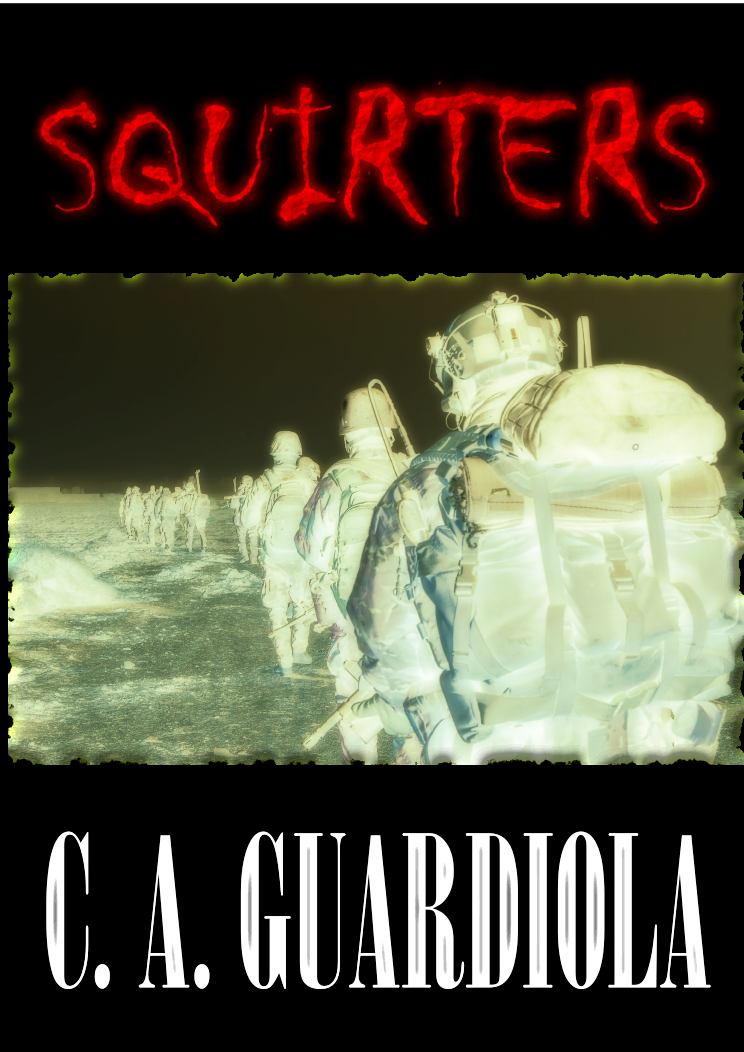
The original cover, bland as a Sunday
pancake with no butter or syrup...

I slipped and tumbled into this abyss early this year when I was hopping to go live on Amazon with my first short story, which I had called, at that time, Squirters.  It was the first piece of fiction I was about to circulate, and I was as nervous as a long-tailed cat in a room full of rocking chairs (I don't remember where I heard that line, but I readily admit I clearly stole that one).  However, thanks to what turned out be a very misleading title, despite 99.9% of the population expecting titillation and porn, I gave them a supernatural war story instead, and a pretty pissed off, otherwise expectant readership was born.  But poor title selection was just the beginning of this mess I made.

Because there's this: the tumult of book cover design goes beyond the usual headache of should I pay a professional or do my own?  A professional, just like any industry, will charge you based on complexity of the thought process, and unless you are buying one of the designer's stock covers, you will not get what you pay for if the road is traveled in fits and starts.  When I was in my teens, I had trouble selecting the exact snippet of a song that would best represent my individuality for my answering machine, so you can see my problem there.  And I haven't outgrown the habit, so indecision can kill this tete-a-tete collaboration really fucking fast.

You have to remain actively involved in the progress of the design, or even a customized job may not work out for you.  Even worse, if the soul of a bitchy art director is trapped inside your body trying to get out, you may also end up frustrating the book cover designer or graphic artist you're working with, and the partnership will end with someone flipping the bird, billing for time spent, and perhaps even a veiled reference to Yoko Ono will be muttered.

Well, I decided not to go that route, for those aforementioned reasons.  I don't have and have never used Photoshop because back in the mid-90's I failed to master the unique male compulsion for retouching photos of women's boobs and lady bits, so that skill set was out.  Plus, Photoshop is expensive and unless it is for a full-time career move, better to grab a Dodge instead of a Lamborghini for your first trip out on the back roads, know what I mean?  Instead, I patrolled the Google landscape and found my way to a couple of free (emphasis on free) graphics programs (GIMP, which you can download here, and Inkscape, downloadable here) and began one of the fastest and most intense learning-curve marathons known to man.

Once that was done, I needed what any red-blooded nerd trapped in his mother's basement with a bag of Doritos and an overclocked Alienware will need: images.  A plethora of images.  And here I was at a real roadblock because not only does my mother have no basement, but I hate Doritos and I can't afford another Alienware.  So I just tapped my Asus laptop on its smooth little forehead and told it, "Go fetch."

A big, big note here: if you are tempted to just find, copy and use any image floating through the digitalsphere...DON'T.  Just don't.  There is a mine field of copyright infringement lawsuits just waiting to shred you and your checking account to pieces -- and a phalanx of online, Starbucks-sipping, Arcade Fire-listening, website-chasing lawyers who have nothing better to do than try to make a quick one or two grand in billable hours filing on unsuspecting or impetuous writers (like me).  Basically, if you are not the person who took the photo or generated the original image, you do not have any ownership rights to re-use that image, in ANY fucking way, unless the owner of that image gives you said permission first.  (And you'd better get it in writing, too).

So the sources I decided to use for this maiden effort came from some Department of Defense websites, mainly because photographs taken by soldiers on active duty are considered to be in the public domain under Section 105 of the US Copyright Act.  NASA is also good, all those astronauts and their high-resolution cameras really have a public-domain gold mine going on if you're a sci-fi writer.  Specifically, the disclaimers on Wikimedia Commons will say something like the phrase below, corresponding to the following image:

This image or file is a work of a U.S. Air Force Airman or employee, taken or made as part of that person's official duties.  As a work of the U.S. federal government, the image or file is in the public domain.

So that's the first thing you should check, and then you can use the image as I've done below:

Credit: U.S. Air Force photo [Public domain], via Wikimedia Commons
Note that even public-domain images need attribution, and Wikimedia Commons will actually have a link on the image page telling you what this attribution should state.

You may run into a lesser form of public domain that will say something else, like this:

The copyright holder of this file allows anyone to use it for any purpose, provided that the copyright holder is properly attributed.  Redistribution, derivative work, commercial use, and all other use is permitted.

Which is almost as good as public domain, except that you absolutely have to credit the copyright holder, because copyright is still with the owner of the image, not you.  So you do something like what I've done with an image under this license below:

Credit: By Georgios Pazios (User:Alaniaris) (Own work)
[Attribution], via Wikimedia Commons
Don't be alarmed by the selection of photos, I'm not planning on bombing any small industrialized nation anytime soon.  I searched for jet fighters and the results provided included the images above.  This can be done with any kind of image that you may be looking for, just like a Google search, except you're going through the Wikimedia Commons repository where most images which are uploaded were intended to be shared, albeit with one or two restrictions.  This will yield better search results than using Google, where a majority of your image search results will probably include copyrighted images.

My revised attempt; and guess what?
It still sucked...
Now, am I a patent and trademark lawyer?  No.  This is all based on information I read on Wikimedia Commons, and if some bloodsucker comes after me, I'm going to encourage them to go rifle through Jimmy Wales' coffers, not mine.  But his Wikimedia Commons page has great information on the images that it has to offer, I doubt that it is there to lead you astray, and it will even tell you if the images are public domain, if they can be re-used with credit given (which is a really small price to pay, so just pay it already), or if there are other restrictions which the copyright owners have imposed on sharing or using the images.  It's all explained in legalese that's as clear as mud, but bottom line, try to go for stuff that won't get you strung up by your thumbs in a courtroom.

There is also a much easier solution to this and that is going out and taking your own photos.  At least, it's easier from a copyright-holding perspective as long as there are no people in your shot.  But I'm a lousy photographer, I don't know a damned thing about filters or shutter speeds or whatnot.  And if you are taking photos of random people on the street, you'll need to get a release from each and every one of them before you can even think of using their faces or likeness for commercial purposes.  If you commission a model for a photo session, however, they usually sign such a release, but you are also paying them for that photo session.  See how complicated this can get?
Finally, a photo that doesn't involve
worrying about fucking copyright...

Notice that nowhere thus far have I mentioned the dark art of skill that needs to be applied to these creative bursts of hemorrhoid-like flare-ups.  Oh sure, you can go out and decide to comb through the offerings of eBay and learn everything there is to learn about designing book covers -- and if you're going to do that, go buy Chip Kidd's excellent introductory book, A Kidd's Guide to Graphic Design, which distills a good chunk of his vast professional knowledge into a very approachable treatment of the subject.  Seriously.  It is that good.

However, even after a revised cover, I saw the zero-sum sales on my KDP page and figured it was time for some professional CPR.  So after some perusing, I found a website and graphics developer at SkyRuby.com which charged me very reasonable rates to prop up what was at that point a dead body and try to at least make it look like it had once walked the earth as a living thing.  This is where I discovered how detail-oriented and obsessive I could be over even the tiniest details.

Call this chaper The Adventure of the Skull Moon...I could write an entirely separate post on the imagery that haunted my brain, just trying to get that thing right.  The skull moon was a key image in my concept of the cover design, you see.  But the original skull moon was this:

Revision No. 3; or How I Learned To Stop
Worrying and Prematurely Love
My Skull Moon...
I had decided to change the title and was using a half-assed placeholder title, but I still wasn't feeling that skull moon...it looked sad and maybe a little hungry, like a kitty cat that just wants to be let inside the house.  Those Special Forces soldiers aren't heading into danger, they're embarking on a mission of feline mercy to deliver a bowl of milk.  And the title?  Might as well have called it Waiting for Cuddles.

Problem was that I had already told the designer that I was happy with the outcome...but I wasn't.  It was like tasting jalapeno poppers for the first time: you don't really know it at first, but you keep eating them and suddenly get up from the table knowing that, somewhere along the way, you've made a grave mistake.  And this is a key thing to remember when you are working with a professional: don't be afraid to speak up.  You're paying for services rendered, you have to be able to say what's on your mind.  This isn't your marriage, no one's going to bitch you out for admitting you hate to get up early to take out the trash...um, yeah, anyway.  So I emailed her again the next morning and said, Hey, we need to talk...

The designer I worked with was very patient, and she charged by the hour but she brought mad skills to the game and worked very fast, and in a matter of just two hours (I shit you not) I had a much better skull moon, the best one I think I will ever find.

And what did I end up with?  A final cover, which now looks exactly like this:
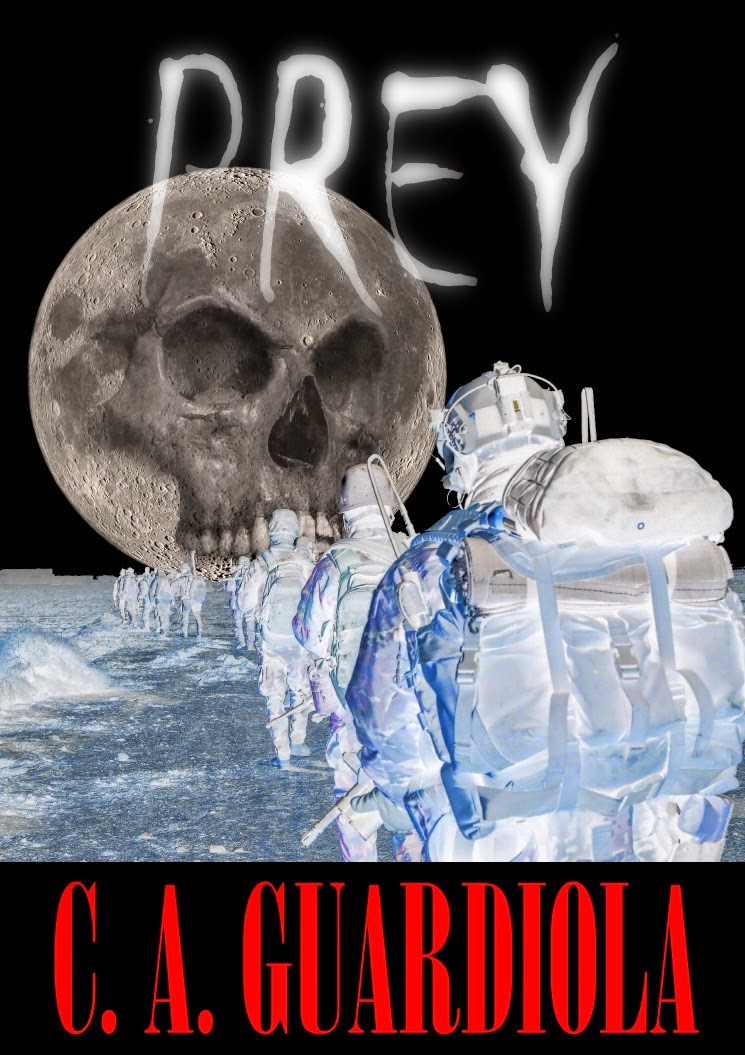
Prey.  That's right. Prey.  As in, "pray" that this is the last
fucking change this asshole makes to his book cover...
The moral of the story is yes, I am a control freak, yes I drove my cover designer crazy andd you can, too!  But fuck it because you know what?  You will get a cover design that is much closer to what you envisioned than if you were to hand the reins to a publishing firm.  Publishing firms have their own designers and art departments and they decide on a marketing plan, not you.  They decide what your cover will look like, not you.  They may even decide to change the title of the book, and suck it up, buttercup.

I'm made of much more arrogant, self-centered stuff.  I want my ideas, my concepts, my execution out there.  This is not the way for everyone; I sincerely understand that.  For those who have already reached the hallowed halls of traditional publishing, giving up final cut, as it were, in exchange for the freedom to write more stuff may be exactly what they want and need.  But I'm having a hell of an adventure in this indie environment, and I'm in no particular rush to do anything except enjoy the ride.

I'm speaking non-pornographically, of course.

Sunday, September 21, 2014

The 7-7-7 Challenge: Or, I Just Have Seven Sentences...

For this latest outing I have to thank fellow scribe Paige Randall, who will slide a tumbler of bourbon across the bar to you, give you a friendly nudge, and in quick measure proceed to drink you right under the table.  Paige is an expert in the microdynamics of male-female interactions, from the heady onset of romance to the harsh reality of the breakup.  This makes her a great observer and chronicler of the most complicated facets of our human condition.  Who else can trace the emotional algorithms of pain and joy, friendship and betrayal, and reshape the psychic experiences into words that everyone can relate to, except the most gifted writers and poets?  Paige is one of those people.

One of the spots where Paige ruminates on the human condition and proceeds to shoot down thoughts of the day; it is her personal Dealey Plaza... (photo courtesy of Paige's website, because she is way cool like that)
Paige also has a great romance novel, Circling, which is winding its way to the reading public, and she is already working on its sequel.  She lives in DC and spotted Janet Napolitano once; if you're a fan of cutting wit, cuss words and no-holds-barred straight dope, go check out her blog right here.

Without further ado, then, below are my little creations:

Captain Anton Brubaker knew better. He had fought and bled and survived and managed to hold out this long, but a part of him was gone. It had been gone for a while, therefore what he had just done didn’t insinuate itself in his mind with any crippling sense of conscience. He sat in his chair and reflected on that. He was calm.

Blood seeped along his right sleeve from where one of his sergeants tried to stab him with a pair of scissors just over an hour ago. The cut along his bicep was deep and painful, but that sergeant was also dead in the secured server room.


And thus begins the second part of my short story Dead Air Dying Sky; this scene follows the first scene where a group of pilots begin reacting to something happening to them while in flight, and the skies are soon peppered with the flying dead.  It may help you to know that the original title of this story was Zombie Pilots Over Tulsa, but for purposes of avoiding the narrow straits of niche marketing, it was suggested that I veer away from that one.

The new title was actually suggested by the spouse of a friend.  That switch in the title will likely save the story, as poorly chosen titles can capsize even the sleekest of Ohio-class nuclear submarines.  I will forever be grateful to them for recommending this.

Why zombies?  Oh, I don't know.  Why does every truck driver in the world seem to be able to find the Walmart parking lots with disturbing divination?  Why do bluebonnets spring up in the most messed-up places along IH-35 in the springtime?  Why is Outlander so fucking boring?  (Sorry, Suzie K!)  We will never know, and we have to content ourselves with the not-knowing, with simply accepting what we can't ever understand and move on with the lesser mysteries of life.

Well just like Phil Hartman's Frozen Caveman Lawyer, I am frightened and confused by these blog-based challenges I find myself in, and I haven't tagged anyone for follow-up on this specific challenge, either (sorry Paige!).

Instead, I'm going to list a host of writers off the top of my head who I have met on Twitter and who are fellow rowers, those who together have shared the ravings of galley slaves, who suffer the lashes of the creative whip, and who pray for the break of dawn known as success, however we choose to dress up that little buttercup.

And here goes:

Paige motherfucking Randall at PaigeRandall.com: I don't know what her occupation is but I think she's either a lawyer at a PR firm, a lobbying firm, or some other kind of firm.  Too smart for the federal government, in my opinion.  Her blog has great insights on the creative process and the adventures of trying to find an agent in these complicated digital times (remember, the road to hell is paved with agents making you wait for weeks on a yes or no).  If you want to laugh out loud right now, read her blog post, "Ode to the Gym."  Yes, yes, I know I mentioned Paige already at the top of this post.  But she set me on this challenge; it's only fair that she get extra credit.

Kenneth Harmon at GhostUnderfoot.com:  Kenneth is a fine writer whose novel, The Amazing Mr. Howard, will be published by JournalStone in early 2015.  I told him once that his writing style reminded me of Robert Bloch, and I meant it.  He and I direct-message quite a bit, and in addition to being probably the number-one cheerleader I have on Twitter, we have shared a keen interest in wordsmithing, a general gripe about the pitfalls of traditional publishing, and a too-detailed discussion of enlarged prostates, an affliction whose burden, fortunately for him, is not his to bear.

Eric Keys at EricKeys.wordpress.com:  Eric is an aficionado of that special brand of fiction that blends horror and erotica.  Sometimes I call it "horrotica" and it reminds me that I'm no poet.  His novelette, Grace and Blood, is probably the best example of this structure, and it's available on Amazon.  But his most personal piece is probably "A Single Act of Prolonged Vengeance," which was anthologized in an inaugural volume under the title A Light in the Darkness as a collaborative effort for Writing Out Child Abuse, and is also available on Amazon.

A.U. Gonzales at scriptogr.am/infinityinthemiddle: A.U. was so drawn to the craft of writing that he resisted his family's urging to continue a trans-generational career in the medical field and become a doctor.  It's not every day you get to tell your folks you're following a far different path than what they expected, so he is to be commended for his bravery and his confidence.  And his skill: go check out And Then Acid Fell, an anthology of very well-written stories connected only by nature's soft wrath.  It's available on multiple platforms, including Amazon, Smashwords, Google Play, pretty much every damned digital platform A.U. could think of, and then some.

Kym Darkly at TheHorrorInMyHeart.com: Kym's narratives, which appear on her blog, are little gems of madness, a storyteller by the fireside entrancing her audience with her latest tales.  She has also recently posted a very interesting and insightful interview with a demonologist.  The best place to enjoy the horror in her heart is to go to her blog, also titled in like fashion.  My only complaint is that, although she has written many television and film scripts because her influences come from that medium, she hasn't yet published a longer piece, but I suppose I could characterize her as the female version of Thomas Ligotti.

Teresa Hawk at TeresaHawk.com:  Teresa is somewhere in a classified location in the Nevada desert (okay, okay, it could be Area 51) and she writes full-time while waiting for the zombie apocalypse that she is certain will be upon us soon.  Her story Meat had a very Southwestern Gothic vibe, if I do say so, and Death Ray Potato Bake was a total blast to read.  And speaking of blasts, she also shoots guns, many many guns.  Very precisely.  So for those who wish to tread on that classified location, remember that curiosity killed the wandering zombie.  Anyhow, her work is available on multiple platforms, including Amazon, as well as through her website in PDF direct-download.

Katerina Baker at KaterinaBaker.com:  Katerina is an accomplished traveler (I think she was in Budapest the last time we tweeted, and I encouraged her to run along the rooftops like Liam Neeson in Taken 2).  I can only assume she uses her acumen of observations from her bad-ass trips to weave the interesting settings for her stories.  She's a daytrader or stockbroker or something related to the financial industry by profession, and a self-described unrepentant romantic.  Check out her musings on her website's blog for inspiration and a sampling of her great storytelling.  Her books include All Roads Lead to Anatolia and The Day I Became a $py.

A.S. Washington at ASWashington.com: A.S. is both a writer and a poet; but his poetry is meditative and graceful, and his sword-and-sorcery fiction (check out An Insurrection, his latest short story) is violent and visceral.  A family man who practices martial arts, he has gone down from 300 lbs. to I think he said about 204 lbs. on his last post, which is an amazing example of perseverance.  His debut novel was The Virgin Surgeon and his first book in the Danger Kids Universe, The Twelve, with co-author DeQuan Foster, has one of the most compelling and vibrant cover designs I've seen in a while.  Go check them all out on Amazon.

There are many other authors, writers, poets, artists, and talented people I've met on Twitter that I can't list here today for reasons of space and the annoying ring of the dinner bell, but I'll feature them in subsequent posts, just because that's the sort of kind, compassionate asshole that I am.

Tuesday, August 19, 2014

COB Journal: My Writing Process

This is my first but hopefully not last blog hop slash whirlwind spin into the creative process.  I've read an entire bookcase of tomes about the writing process, some good, some meh, but all have helped orient me to the details of the craft.  Many thanks must go to fellow writer, Twitter colleague, and maven of cutting wit, Susan Kicklighter, for sending you crashing through my front window.

Susan's excellent and very entertaining insider view of her writing synthesis can be found at this Tumblr post.  Thank you, Suzie K!

1.  What are you working on right now?

Right right now, I'm finishing the last couple of scenes of a short story called Dead Air, Dying Sky, and if this was a Hollywood schmooze-fest in the back room of the Viper Pit, the high-concept pitch would be Zombie Pilots Over Tulsa.  Which was, in fact, its original title before I hijacked the narrative and took the whole thing in a different direction so that it became less Sharknado and more Jaws.  The title had to go, it was just too tonally inconsistent, and the last thing you want to do as a writer is mislead the audience, violate that implied contract.

My Own Private Oklahoma...
The story itself should be ready for prime time in about another week as I write this, fingers crossed.  The project began just a couple of weeks ago after two fellow writers, Teresa Hawk (her website is found here) and Eric Keys (his website here), basically Twitter-dared me to do it after hearing the title.  It was just one of those zombie-story brainstorms that took on a life of its own, no pun intended.  Sometimes you just have to follow that flash of inspiration down into the rabbit hole.  It can lead you to some pleasantly surprising places.

I'm really proud of this particular little number because I have never written at such a fast writing pace and come up with what I think are a very effective set of scenes which form a prequel to my upcoming novel whose title I am still mulling.

Besides that, I'm also in the middle of another short story and two novels which I am aiming to finish by the end of September or early October, in time for Halloween.  At my age, I have to push myself to keep writing and finish because the ideas just keep coming, and if I don't commit them to their digital homes, they'll go out into the street and start mugging people for cash and recreational weed.

2.  How does your work differ from others in the genre?

Funny thing.  Some time back I picked up a copy of The Secret History of Science Fiction, which is an anthology of authors whom people don't normally associate with sci fi, and one of the contributing writers, T. C. Boyle (who penned the excellent Descent of Man), said art "is supposed to be unconventional" and he wants "to be taken to a different place every time."  Now, in that same blurb, T. C. was kind of an asshole because he called genre readers "morons."  And I certainly don't mind calling him an asshole if he is not going to mind calling me a moron.  (Laughs).

I find it laughable that he didn't seem to realize, or didn't care, that he was being included in a book specifically marketed for genre readers.  But more seriously, he was addressing the general issue of predictability in fiction, which I don't think is a failing exclusive to any genre or literary work in the first place.  We've all sat on that couch staring at a plot twist on a TV show or reading a key exchange in a scene and said, "Oh come on, there was a better way to do that!"  It's that impulse to do it better which drives me and fuels that creative engine.  All of us have it.  We are all born with that instinct to improve ourselves and what we see and hear.  And when it comes to creative writing, some of us just want to actually put that baby out on the highway and drive it, and see where it will take us.  Because we know there is a better way to do that.

3.  Why do you write?

Wow, this one is tricky.  I used to write because I wanted to tell stories.  But the stories were very poor quality, maudlin in many cases, and the narrative was making all those fundamental errors that rookie writers make.  Shifting points of view within a single scene, collapsing and summarizing important scenes while dragging out minor ones, dialogue that meandered and didn't accomplish much of anything.  By all indications, I should have never been that creative sperm which found that egg called Writer's Digest.  But that magazine opened up my mind to my mistakes, made me read books about the craft of writing, excellent and everlasting-truth books like Gary Provost's Beyond Style: Mastering the Finer Points of Writing.  I did so much reading back then.

The first rule is we don't talk about writer's block.
But back then, I wanted to write in order to make money and become famous.  Which are still perfectly valid goals.  They just aren't mine anymore.  I highly recommend to any writer who will listen to me, go out and download a free copy of Michael Allen's The Truth About Writing (or I can e-mail the free PDF copy that the author himself provided to anyone who wants it).  It is a sobering look at not just the publishing industry, but one's chances of becoming rich and famous in that industry.  His special dose of reality took the pressure off my mind of becoming rich or famous, and to just concentrate on that bottom truth which was the essence of my creative impulse: I write for a sense of self-satisfaction.

And you know what?  My writing improved; my ideas improved.  I didn't care if a particular story would sell in a chosen category at the Barnes & Noble Superstore.  I don't care if anyone ever reads my stuff.  I want to feel that I was able to write what I wanted, when I wanted, and how I wanted.  And I feel that I've actually reached that point, the tip of that hierarchy of need that Abraham Maslow started calling "self-actualization."  Creatively, it is the most liberating feeling in the world, so Maslow must have been on to something.

And that's why I write.

4.  How does your writing process work?

These days the creative seizures are happening so often I've started timing them to see how far apart they are.  Everything is inspiring me and I am literally near my laptop as often as possible, and when I feel a flash of something, the germ of an idea, the notion of a narrative, the spinning web of language and imagery, I commit it to its digital realm.  It may be nothing more than one sentence or it may be several scenes of a story.  But if you are serious about writing, you absolutely positively cannot afford to ignore that creative voice, because if you do, it will start to go silent.  You don't lose it, you can never lose something like that, but it becomes harder to find if it goes silent for a long time.

Everything else is just scheduling and coordination: when you write, how long you write, where you write.  Those things all vary depending on everyone's lifestyle, so it doesn't behoove me, or them, to get into any of those details and start making recommendations as if suddenly someone out there is going to say, "Oh shit, so I need to write first thing in the morning!"

Don't get me wrong, I am reluctant to say that those habits are not important, because they are in a tangential fashion, but the most important thing is to commit to paper (or MS Word document, or Scrivener binder) those little hobgoblins of ideas that won't stop yammering at you.  They are the left-brain part of you trying to get out and expose their private parts to the world.  They are the part of you that makes you unique.  From those raw materials, you will hammer out your future novel, poem, short story, script, play, music video, etc.  Listening to and following an idea is the hardest element of writing to master, I think.  The words?  The words will come, subject then verb then direct object.  Don't stress out over style, it will come eventually.  Grammar is important, but only because bad grammar causes distraction, and you can't afford distraction when you are storytelling.

And one last thing: make sure you finish what you start.

**********************

Well that was fun, it's only almost one o'clock in the morning in my neck of the woods.  Again, thanks to Susan Kicklighter for this great chance to stretch my writer's legs and chat with the denizens of the digitalsphere.