Friday, February 16, 2018

Plunking the Target

We call him Quags and he gets paid to plunk the target.

He's sitting on the back of a cargo bed in a POV that's against regulations to even bring on the range, but he's good with most weapon systems and he knows his shit and thus the commanders know better than to fuck with him.  He's also sporting an OD-green T-shirt over tan 5.11 pants and civilian hiking boots, trapped in the girth of a man ten years his elder, and wearing that outfit is about as non-uniform as a uniform can get.  The disregard is deliberate, a public declaration of open derision: no one fucks with Quags.

"When did we go to an OD shirt, Quags?" someone behind me taunts, but Quagmire is steady of hand and furrowed of brow, examining a Leupold scope on his M-4 that probably cost him the equivalent of three months' pay.  Even with a daughter married and living somewhere in Japan, even divorced twice himself, everyone wonders what trailer park he must live in to afford the rest of his money on that expensive shit just because the company wouldn't buy it for him on an official-use budget.  Some guys are obsessed that way.

"The fucking shirt?  THE FUCKING SHIRT?  I get paid to teach you all the dark art of death!" he shouts randomly, then reaches into his bag of fried pork skins and munches down before wiping his hands on the tail of said shirt and going back to focusing his scope.  It's a beauty, he told us when we started drifting onto the range and he was already there, speaking to no one in particular but more to himself as a kind of prayer, toiling like a kid with a new tinker toy.  ACOG-green sight true and bright as the light from your momma's ass-crack on the day you shitheads were born.

No one is impressed with Quag's poetry, but he could give a shit what impresses anyone.  He's what we call a "senior," a veteran troop in our unit with so much time in that he is virtually untouchable for all but the most heinous international incidents or assorted acts of Congress.  He's also our range officer, and we've been slow-roasting our skin to a golden brown, waiting around to qualify so we can be done with this shit and hit the road back to wherever we came from.  Lordsburg, Anthony, Deming, Pilot Point, Beeville, Lake Calcasieu, whichever corner they originally spat us out to all those years ago, when no one in our region or at HQ knew what the fuck they were doing.  That was our golden age.  The newbies getting hired on are under mobility agreements, told to pack their shit and report PCS in thirty days on the slightest itch of whims to newer and more distinct hellholes, so none of us old-timers these days gripe about traveling three to five hours just to watch Quags fuck around for a while.
Photo courtesy LTJG Matthew Stroup: FOB Farah (Wikimedia Commons: public domain)
 Quags actually resembles Matthew McConaughey but that first nickname didn't stick because it was too long, "Mc-CON-augh-hey," so they went with "Awright awright awright" for a while but it was still too long and it was shortened to "Awright," and some commander from another region mistook it on the roster sheets for a reference to Family Guy and they started calling him Quagmire seven or eight deployments back, and finally here in his home region, in his area, they started calling him "Quags" and it turned out to be the nickname that finally stuck, in the weird social filtering of how these things eventually stick under the power of a cosmic momentum.

"You gonna outshoot everyone again, Johnny Utah?" Quags finally calls down to me, not even looking away from the scope, and I'm wondering just how long it's going to take him to zero in that fucking thing.  I want to shoot and I want to get the fuck out of here, same as every other range day.  For some reason, no one thought it was too much trouble to give me the nickname of Johnny Utah or to pronounce it.  It was certainly longer than my real name, my Christian name, the name everyone else used to a point of reckless abandon on the road and in the halls.  The story of how I got it was lost to oral history, a misunderstanding so boring that even thinking about it made my head hurt.  Did I mind?  What the fuck would it matter if I did?

"I don't shoot," I say to Quags, "I think of God, and God shoots through me."

Opie and Bungie Boy behind me are chuckling and waiting to see if Quags is going to bat it back to me, another round of pointless dialogue passing for entertainment in an afternoon far better spent hunting or fishing or just trekking through the wilderness surrounding us.  Opie is about as crew-cut apple-pie as troops can get, plucked straight out of a Mayberry-like utopia and dropped into a Byzantine operation like ours that would have corrupted lesser men as it had corrupted me.  But he was doing just fine, all smiles and good-natured joking even as he put in the same years I had, and for more than just a few measured moments I wondered what it was like to be that normal.

I look around to see where Old Man Paulie is lumbering about.  Maybe walking off his gout because he thinks that's a thing, or possibly just taking a piss in the converted mobile home tucked behind the range office.

Old Man Paulie outranks us all, even Quags, by longevity if not by reputation.  Take a map of the CONUS and point to a spot, and chances are wherever your finger lands, the Old Man had been within fifty miles of it during his forty-plus years of service, seeing some shit and pushing it back.  He told stories with that grizzled, laconic lilt of his voice, a combination of a deep-throated pronunciation of vowels and a sort of half-hissing, fricative set of consonants that gave every spoken narrative an endearing, masculine musicality.  When he talked, everyone listened, even Quags.  The stories themselves were not necessarily important, no life lessons to be weaned, no vital illustration of a meaning.  We listened to them and understood him, how he handled things, and in so doing we understood ourselves.  Even if he didn't know he was teaching; and even if we thought we already knew the lessons.

Quags warns us to get our asses on the line like we've been languishing of our own volition, and because there's a bunch of crazy assholes wandering the environs like nomads of the hinterland, waving around guns and deigning themselves sovereign whatevers.  We call them nutcases and put them in a box and deal with them in accordance with a very specific sequence of actions, and we move on.  "Hank up in the office says that old coot is still out there," Quags intones with the baritone seriousness of Odin himself.  "Says this property was stolen from his granddaddy."

Bungie Boy, who crawled out of the moonshine stills of backwoods Georgia and narrowly avoided burning crosses in Darien like his own granddaddy had done back in the day, chuckled and said, "Where I come from, possession's ten-tenths of the law, ain't no turnabout."  Next to me, Bungie Boy is an excellent shot.  Then again, most of our area shot expert on qual day, so I really had no bragging points to rack up on my abacus.

"Summon the Lord," Quags tells me as he passes behind me forming up on the line.  "I want to see nothing less than a 248, Johnny Utah."  I'm personally insulted that he thinks I could dip that low, but I shrug it off, deferring not so much out of personality and more because in another year I'll need his recommendation to get a spot at FI school.  Just then, Old Man comes up behind us as if he's been there all along, saying, "Les' see how we gonna shoo' today, maybe this dog got some tricks lef'," in that trademark singsong hissing.

We pull on our eye and ear protection and hear the range commands and we've done this a thousand times, it's easy shit now.  Quags starts us off on the one-and-a-half and we don't hear him anymore, we know the spots and how to walk out the yardage and what the tap, rack and reload drills are.  We hear Quags just barely over the din of our own joking and snickering, the most unprofessional, lazy-ass casualness permeating the holiest of acts, on qual day no less, jokes about getting drunk or wrecking vehicles but mostly about what we love to do, which is piss off our commanders.  We finish at the 25 and holster up, and hear a distinct popping of someone still taking shots somewhere up in the looming hills, and we look around playing the game of Name That Caliber.

"That sounds like a thirty-ought," said Opie.

"Shit," said Bungie Boy, "that's an old-school M-1 probably.  Not loud enough for a thirty-ought."

Quags stepped into our line at that point, his eyes searching ahead of him, and he seems to be listening with us.  We wait for his pronouncement, and it takes forever, until we wonder just how focused he must be on that sound, which has already dissipated and taken our collective interest with it.  He turns slightly to his right, then stops and switches to a slow turn to his left, looking directly at me.  His face has changed into one of confusion, grasping at something indefinable and elusive all the same, as hard as it is to try to find something that is not clear, an answer, a way out, whatnot.  What I do get is a sense of movement of internal imagery behind his eyes, alive and grasping, and not understanding.  Didn't he do everything right?  How could something like this happen?  It was a lost look, the kind I got sometimes from the people I handcuffed for being in the wrong place at the wrong time in their shitty lives and now they're taking a ride where the nature of how they fucked up will be documented on an official opinion that will follow them for the rest of their natural lives.

Photo courtesy LTJG Matthew Stroup; FOB Farah (Wikimedia Commons: public domain)
I spot something in that look that bothers me, and I step forward even though he hasn't given the all-clear command, and I grab his shoulder and say, "You okay, Quags?"

Quags falls to his knees, and I barely grab him before he pitches face-forward into me.

*                    *                    *

Quags died that evening.  Hiskins, our commander in the area that day, had tried to get in touch with his daughter but never was able to reach her.  The doctors had a fancy name for the myocardial infarction; I forgot what it was. I forgot it because nothing went according to script on the day Quags died.  You expect crying, cathartic releases of anger against God, declarations of unfairness, somber, manly hugs and gruff attestations of the goodness of the deceased's character, solid as oak and replete with promises kept.  I saw none of that shit go down.

Instead, Quags' ex-wife sat on the waiting room sofa with eyes as dry as an ancient river bed in Death Valley, and she smiled, she fucking smiled when anyone walked up to her and gave her their condolences.  I wanted to walk over and shake her and say, What the fuck are you smiling about you dumb bitch, the man you used to love is dead.  The father of a daughter he adored got his ticket punched; how about you emote a little more?

Hiskins had made it into the waiting area but then walked down the hall to talk to his bosses about an entirely different pseudo-crisis involving overtime and travel for another one of us in a different city.  Because even in the face of personal calamity, the bureaucratic beast growled and wanted to be fed its routinized, apportioned sustenance of meaningless bullshit.

I spent part of the time standing around and watching a little boy play with a plastic toy that he kept throwing behind furniture and waiting for his mother to tell him to stop.  Down another corridor, an old man laughed with a doctor and a nurse as they pushed him out of a room.  I remember the smell of the corridors and waiting areas.  They smelled of an antiseptic, indescribably pungent cleaning fluid.

Life was moving on without Quags, and nothing about what was left in the wake of his space-occupation and atomic movement was especially memorable or defining.  He slipped in and out of a series of moments that had been coded for everyone else's daisy-chain.  He was supposed to have mattered to this loose circle of a few, and apparently he didn't, not memorably enough, anyway.  And now, selfishly, all I could gather for consideration was who would truly forget me when I was gone.  How unmemorable I would be, based on the tapestry of pitifully outlined non-reactions rolling out before me this evening.

And I came to understand in that flip-book moment just why everyone hates to go to funerals, or give condolences.  It's a practice run for your own, and you understand just how shitty they are all going to be, how skewed and uncoordinated, how misdirected and bland.  There is a sense that things were rushed, never completed as they should have been, and now never will be.  It's the way of things that pass and it can get your head wrapped around the axle pretty fucking fast.

I wish I could describe Quag's funeral, but I decided not to go.  It happened at the last minute.  I showed up and stopped at a local eatery to have breakfast, and I was staring at a Coors Light poster that looked really old, depicting a cowboy in a Jeep CJ, and it reminded me of one I had seen in my dad's garage when I was a kid.  And I just whiled away the minutes contemplating the nothingness of its implications until it was too late to finish the drive to the cemetery, just filled my mind with this emptiness that went nowhere and had nowhere to arrive.

I don't know why I backed out at the last minute.  The poetic part of my brain wanted to say something about remembering him in his final moments of awareness on this planet, the last look in his eyes before he collapsed.  But mostly I think I just got chickenshit.  Instead, at the precise point when they were lowering him into the dirt, I think I stopped at a gas station and bought a pack of M&Ms.  If I was worried about finding a moment in Quag's life, or death, that would be laden with meaning and import, I had just consigned it to an epitaph of meaninglessness that apparently importuned no more.

Tuesday, February 13, 2018

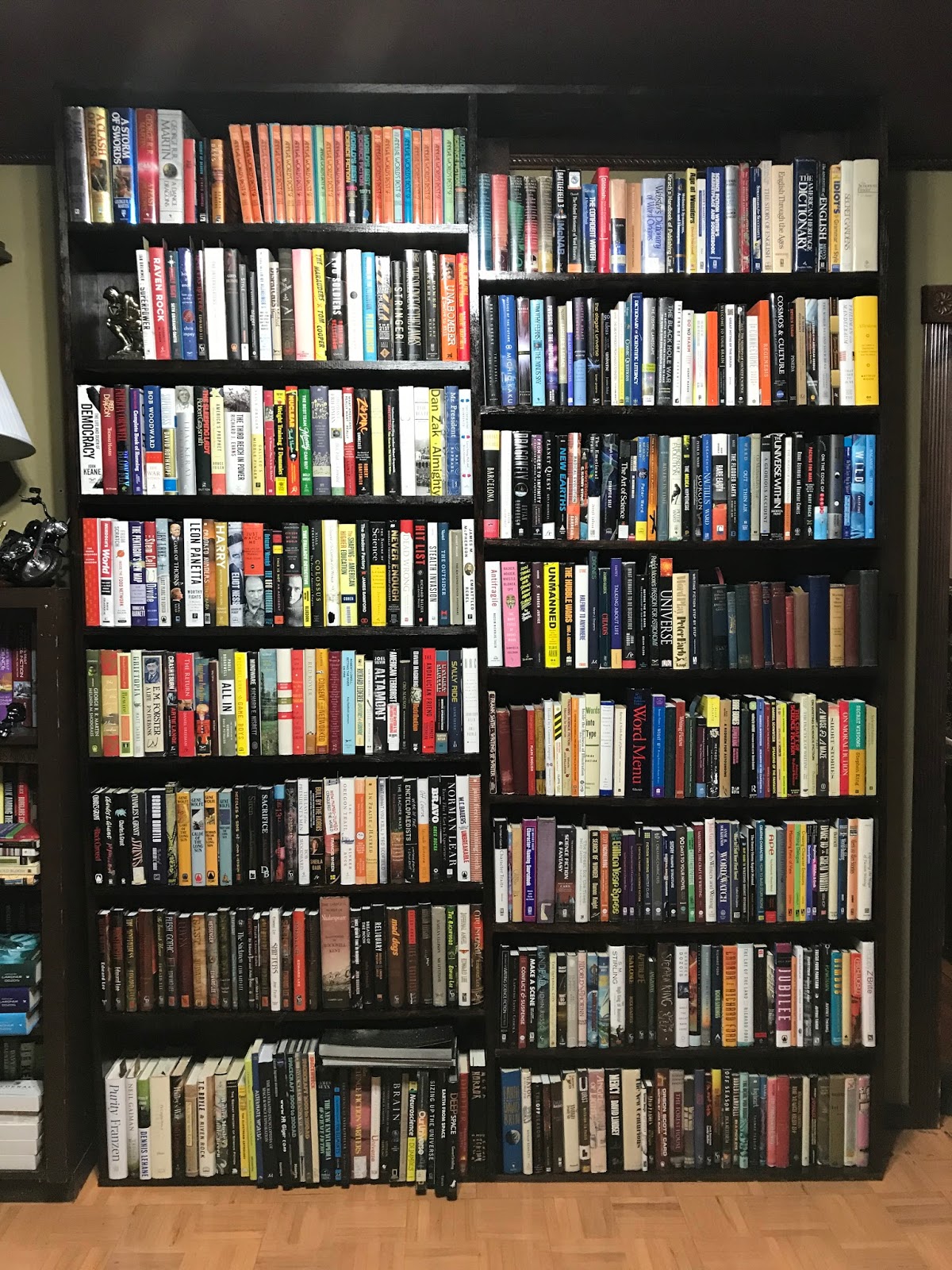
The Bookcase

My book collection was out of control, which meant I was out of control, but I found it easier to spend more money to fix a physical effect than to address its root behavior so fuck it, off I went in search of a Home Depot.

Me practicing my best Mel Brooks' "It's good to be the king" line from
  History of the World Part 1. And yeah, said bookshelf is behind me.
It was one of those home improvement projects that you cook up in a half-delirious phase between the fugue state of not remembering why you went into the kitchen to not being able to commit a sketch to paper for lack of your favorite Levenger pen with the Piper 1000 Ultra-Glide ink barrel.  Excuses, in other words.  Fancy-ass excuses.  And within these walls, as soon as thoughts became cogent and pronouncements were made about this project, the salvo of objections came in early and often: the history.

History has not been kind to home improvement projects in this house.  There was that time I got locked out of the garage and had to break in by crawling through the bathroom window.  People still make fun of that day, cruel, unforgiving people, but it happened many years ago, before cell phones were invented, and leaving the keys locked in the car meant baking one's skin in (where I live) 100-degree heat for the majority of the day, or walking to a convenience store and loitering in air conditioning for the next several hours like a pervert in search of a newsstand with the good stuff on the bottom shelf.  I'd really be stuck, at least until someone came back with the fucking car.  Getting locked out of a house meant being forced to walk the earth and eke out food and drink by any means necessary like in The Walking Dead, I'm not fucking kidding.  Anyway, the point is I had to fix that bathroom window and it still doesn't close properly.  The history, the horror.

The next challenge on my bookcase project was the prep work.  And here is the true secret of carpentry: it involves geometry.  It means measuring with some degree of exactitude.  I took exactly three semester hours of algebra in college and that was all I had to take and I ran like hell from anything that had numbers in it for the rest of my undergraduate studies.  Geometry, trigonometry?  Those were nowhere in sight, not even in high school, and purposely so.  So the handicaps here were set firm and set early in my young-ass life.

 A bookcase has to take into consideration the width of the shelves themselves; the space required for the height variance of trade cloth editions; the oversized aspect of coffee table books because the fucking things still have to be shelved somewhere since there is only ever one coffee table in a living room and you can't stack them forever like some Howard Hughes psychopath; will said bookcase have a toe guard or no toe guard and what the hell does a toe guard serve anyway; and so forth.  You don't just bowl up one day and say you're going to build a bookcase and take up hammer and nail.  You have to sketch the fucking thing out.

Behold the bookcase in its natural habitat...
The next challenge is the visit to the lumber yard.  Here you have to mix it up with hard-eyed, serious men.  Men with worn leather steel-toed boots and dirty jeans and terse, clipped vocabularies that cover a lot of ground with a single, "Yup."  To approach one is to risk exposure, to be revealed as the weekend enthusiast that never fully matured to craftsman or carpenter.  "You gonna use the 5/16 brights on that one, or you gonna go with wood screws?  You gonna need wood putty?"  How the fuck would I know?  So many questions!  So you have to go off on your own and figure out which length of wood board you need, what the fuck is yellow pine and why so many black knots and why is white pine so clean and so expensive Jesus fuck?

If you travel to the lumber yard by yourself, you will need to practice your pose.  Specifically, standing and observing the stacks of lumber as if lost in the deep art of calculations and estimates and not because you have no fucking clue what to buy.  Go up and look at the wood as if inspecting it for fissures or cracks or Kosher labeling, because every minute will be filled with the terror of being discovered.  Every nuance is judged, every verbal utterance is logged and remembered by the Home Depot employees who lurk close enough to note your actions, but far enough to not really be helpful.  Stare too long at the price displays and they will figure you out as nothing but a yellow-bellied novice.  Buying lumber by yourself is a harrowing experience that will require ice water in the veins and a steely determination to make your choices quickly before you betray your limited knowledge and get laughed at by the cashiers with a sneer and a low, cutting comment such as, "He'll be back when he finds out he needed sluiced boards."

However, if you travel to buy lumber with another person, specifically someone of the opposite sex, be prepared, conversely, to undergo a vetting of your knowledge of said project more thorough than CIA screening of potential agents of state-sponsored terrorism.  You will not be free to just buy at the pace of casual whim; every choice, from color and texture to height and width, will be scrutinized and require an oral defense as if your doctoral dissertation is on the line.  Leaving the lumber yard will carry the weight that you survived negotiations to rival peace talks at Helsinki, or the questioning of potential war crimes in The Hague.

The final challenge: the actual work.  Here you toil, again with hammer, again with nail, enduring blisters where blisters have no business being, and the petty barbs of neighbors who privately snicker that they wouldn't trust you to change a light bulb without damaging the wallpaper.  Here the matter cannot be bungled, as Tom Wolfe said about something else entirely.  Here you must drill and saw and chock and measure and drop boards on the ground and slam them into each other like a man possessed of the singular notion to finish the day's labors by the sweat of his brow.  The sheer noise and clatter that you make will signal to everyone that you are not just serious but, like, really serious.  And you will stand arms akimbo at the end of a long, hot day without pause from the heat and dust, and you will look around and think, Shit, all I finished was the frame?

And the inter-challenges will arise: the mundanities of life like trips to pick up kids from football practice or a faucet that sprouted a leak or the neighbor is calling the cops because you vandalized his trash cans again that morning, with malice aforethought.  So you won't get to dedicate the time to the project that you wanted and you won't make the progress that you wanted and this part is important because this is where 99 percent of the weekend amateur carpenters just throw up their hands and give up.  I can't tell you how many times I went back inside the house, plopped down in my favorite chair, felt the welcoming puff of 72-degree comfort cooling, and said, "Let me just finish this next level of Fallout 4 instead."  Embrace these self-induced respites, for they will keep you sane.

What's important is to remember that you've already spent a fuck-ton of money on building materials and even if you end up with a very expensive wooden ashtray, just make some use of your misguided and embryonic efforts.  Besides, the last thing you want is to not finish something so that ya girl go and dog you out when she with her friends, see?  (Apologies to Tupac).

So after failing to slaughter the mutated Deathclaw that roamed the village in Fallout 4, I put down my Xbox controller and went back outside.  I cleared a path for the raw bookshelf to be carried in without knocking down something important or breaking the glass on the sliding door, through which I would perhaps attempt to crawl through again just for old times' sake, just to be wistful, and then I wheeled it inside, shimmying it like I was a smartass warehouseman in Dire Strait's "Money for Nothin' " video.  And I was pretty proud of myself, until I realized I still had to stain the damned thing.

The finished product, i.e. dead trees holding
other dead trees...
Here, then, is where it all falls apart, from the pretty how-to books and video demonstrations to HGTV-propagated bullshit where people, calm, rational people in casual yet elegant weekend clothing from Kohls, carefully review their color selections and discuss their perspectives on cock-ass names such as baroque chocolate or warm sienna.  Because after all that work to put the fucking thing together, all I wanted to do was walk into the paint section and tell them, "I want something that's dark."  Which I did, only to hear them say, "Would you like to look at our color plates" and I scream "NO ASSHOLE I WANT SOMETHING THAT'S DARK!  THIS ENDS TONIGHT!"

So the angry clerk tossed me a can of Minwax inocuously, perhaps generically, called dark cherrywood and he nearly hit my head, but the Home Depot motherfuckers know when you're in a hurry and can do things that take you to within an inch of losing your life without calling the cops on them.  Then I got to my study, laid down some clear plastic covering on the floors and furniture like I was going to reboot the Texas Chainsaw Massacre, and what roughly felt like 13 years later, I had a fully stained bookshelf.

I won't even tell you what I went through to get varnish on that thing.

Saturday, January 20, 2018

Death of a Marine

This post is about a friend of mine who died last month.  It's part obituary, part backstory, part requiem, part soliloquy -- all rolled into one.  The obituary I read was nothing more than a brief snippet, altogether worthless of the life she led and the impact she had on others, myself included.

Photo courtesy Melissa M. Shafford
She was Melissa Mary Shafford, raised as a Navy brat from coast to coast until she and her family ended up in a "spit of a town" called Taft, Florida, and later to Sanford in Central Florida.  Back then, their home sat across the street from a lot where a traveling carnival parked its shit and took a long rest between tours.  She said her dad moved them all out of there after a major accident happened on that site and it became important to him that the entire family got the hell away.  Some of her treasured memories included getting dressed up as Batman and assorted superheroes along with her cousins in the back yard; her less favorable ones were generally while growing up in a household where any expression of emotion was seen as a sign of weakness.  She and her siblings weren't even allowed to cry during sad movies because the threat came from her father: "I'll give you something to cry about."  She told me once that what they grew up considering to be harsh treatment is viewed in modern parlance as a physically abusive environment.

Her relationship with her father seemed to be the most difficult experience for her; he belittled her constantly and made her feel like nothing she did was right.  It seemed to only motivate her to achieve the best grades in school, but she stopped considering her home a sanctuary.  Her formative years into adulthood didn't offer a better path necessarily, not at first.  While serving in the Marines, she was raped by another Marine who was drunk and got her pinned down on a bed.  She was too embarrassed to report the rape, but it took its toll on her mental well-being and she ended up with an early medical discharge a little over a year later.  Psychologists could possibly call it the defining moment of her life at that stage; I certainly would have.  She was subsequently diagnosed with post-traumatic stress disorder from that nightmare, but she chose to never confront her attacker.  When I asked her why she wouldn't, she said it had been so long ago, her memory was hazy on his identity, and she didn't want to spend time reliving the horror of something she had already worked hard to put behind her.  I knew better than to try to go near that land mine and try to disarm it all on my own.

By the time I met her, though, she had become a different person altogether: tough, articulate, and thoroughly incisive in her professional observations, such that I never would have guessed as to the trials of her early upbringing until she had confided them to me much later on.  She had no patience for bullshit or bullshitters and made it known early on.  It also made enemies for her, which she knew, accepted and embraced.  She knew when people were being genuine with her and she knew when it was mere sycophancy rearing its head, and she smacked down the latter with a crisply executed chop.  That's the kind of hard bitch she could be.

Which isn't to say she lacked empathy.  She was also one of the kindest people I knew, and it shone through in unexpected moments that you could only spot from an oblique angle.  Some of the people whose lives she touched sought her counsel and ended up in tears from the sudden, cathartic release of talking to her about their problems and listening to her advice.  She brought a clarity to the way she looked at the world and the people who lived in it with all their associated dysfunctions, manias and misguided motivations.  She was direct, and she was blunt.  One day we were speaking about a co-worker named Ron, and she said to me, "I'll tell you how I feel about Ron -- if he's laid up comatose in a hospital bed, I'll clean the shit out of his bedpan.  That's how I feel about Ron."

In terms of human companionship, love, romance, all that sappy shit, she never really had time for it.  She learned to put up walls at a very young age and not let anyone in, and her life didn't revolve around a man anymore, not when I knew her or since.  She suffered through a first marriage to an abusive husband and through a second failed marriage to the extent that her emotions consisted of only two expressions: happiness and anger.  If she had a love of her life, it possibly existed at one point for her Marine recruiter, who was married with kids and was not in a situation where he would leave his wife. "I know how to pick 'em," she would say about that.  She would also say that if he had ever shown up at her door, she would have left whoever she was with to be with him.  Knowing how sparingly she made such declarations, I know what she felt must have been true.

Photo courtesy Melissa M. Shafford
She was on her way to a top spot in our little corporation when her mother's diagnosis of cancer derailed everything for her.  The casualty of that horrifying knowledge also culminated with a series of professional attacks and check-mates that effectively guaranteed a hard fall down the career ladder she had worked hard to ascend, mile by bloody mile.  But the sad truth is that she left a place where the shit was hip-deep to a place where the shit was neck-deep.  She knew that would happen, too.  She fought it as best she could, with no help from anyone.  She soldiered on, in the end spending thousands in legal bills to a law firm that sucked her finances dry.  She did win her case against the government for failing to protect her from an environment of pervasive harassment, but she never lived to see any money actually awarded to her.  The illnesses and PTSD symptoms kicked in hard again, and there is only so much that a person can take when the human body and the human psyche gang up on you.

She was wired to handle the shit at work and the health issues, but Melissa never really recovered from the death of her mother in November 2011.  By then, she had moved across the country, taken a position of lesser responsibility and much lesser pay, endured the ostracism from her new co-workers and bosses, and even sacrificed her lunch hour to leave the workplace every day and care for her mother, with meals, with bath times, with everything that a human being who is preparing to exit this plane of existence ought to receive when diagnosed as terminal.  And when her mother passed on, there was a hissing void of empty space that her care and nurturing had once filled.  I think, looking back, that maybe, absent a significant presence in her life, she needed to be able to care about someone at least, someone she loved deeply and with all her heart, someone who protected her as best as possible and never wished her an ill thought.  When that is taken away, who knows what happens to an uprooted soul?

The last time I spoke to Melissa in person, she still had that hard edge about her, that clarity of considerable perspective, but I could also see cracks in the foundation where doubts and misery were creeping in.  Her family's issues had come full circle such that her father was busy re-imagining the life with her deceased mom as a June-and-Ward-Cleaver love story; her brother was fighting with a nightmarish ex-wife over child custody matters; and her sister was, disgracefully, reveling in Melissa's barely controlled descent after envying a meteoric rise.  Melissa was still the glue keeping that living dysfunction from slipping into more severe dysfunction.  Although I wouldn't have called it a downward spiral, since reality was not gut-punching her to the point that she was on her knees, the ground was still coming up fast for her.

I don't want to romanticize this part of it.  Even in the times when everything looked bleak for her, she found the time to reach out to me and pull me out of my own darkness, to pull me through tunnels and over rocky paths that eventually led to a place where I could catch my breath, look around, and feel the sun's rays sink into my skin again.  Of my own doing, I ran into a perfect storm of bullshit at that point in my life, and she kept me relatively sane, and my soul owed so much to her that I never came back to repay.  She was a far better friend to me than I ever was to her, but she never rebuked me for that; again, that's who she was.  A constant giver to those who she felt needed her more than she needed to help herself.

She lived alone and didn't venture out into public places anymore.  Her closest companions were the ones she loved dearly and stayed by her side through the worst of the storm: her dogs, Jack and Apache.

I don't know how she died.  I hear rumors and ignore them; they don't represent the person I knew, and I choose to remember her for the inspiration and friendship she gave to me and so many others.  I've met many people in life, and some of them, this world could do without.  Not Melissa.  The world is a lesser place without her.

Watch your six, Melissa.  Rest in peace, and semper fi.

Friday, September 1, 2017

Death In Situ: Writing Exercise

At one point in my tortured past I read virtually every how-to book about writing, including a lively tome from Brian Kiteley called The 3 A.M. Epiphany which was essentially a series of writing exercises designed to jump-start the engine of your creative mind.  I hate writing in first-person but one notable exercise involved writing in first-person and trying to tell a story through description while using the word "I" as little as possible.  What this exercise taught me was how minimal the difference between first- and third-person could be, if the narrative was handled a certain way.

It was an interesting, notable challenge, and I managed to write a very lengthy scene out of whole cloth for this one.  I drew on the memory of a long-lost spy story that was accidentally deleted from my old computer when I was in my early twenties, a tale involving an American spy named Eric Stanush.  That first story was lost to memory, and I never finished the suggested story that poked through from Kiteley's writing exercise, but the scene that grew out of it is below in full:


             When she reached the train station at Luxembourg City, all I knew about her optics and movement was what type of coat she was wearing and when her train would leave.  She had one of those shabby, puffy numbers that people tend to see on hippie twenty-something adventurers hiking across Switzerland, or permanently parking their lives in Amsterdam where they were turning on, tuning in and dropping out en masse.  Her hair was sandy blonde, straight, short and loose around her face.  But it was all about her face.  The face didn't line up with the clothes.

(Source: Wikimedia Commons, Informationsstand bannen an der Stater Gare, MMFE, CC BY SA 4.0)

             The eyebrows were thin and intelligent, the mouth was neither too small, too wide, too pursed, too judgmental or too gentle, it was fixed in a set of perfectly prepared mannerisms.  Her eyes moved with a considerate grace, the kind that implied she had sailed through life without serious worry or tragedy striking too close to her, or if it had, she had merely pushed through it and moved on.  Women with an inner strength were far more interesting.  She had an inner strength, but only if she had managed to push on.
            The tasking message had very little information about her name, and normally names are not very important except as labels, but her name had that extraordinary quality of leaping out into the world full-blown: September Mannheim.  Her name announced a hidden aristocracy, a bloodline of landed wealth that had been nurtured, tucked away in Puget Sound or upstate New York among the influential gentry of the eastern United States.  What kind of job did she have?  Photography?  Travel writing?  Something that didn’t require business attire but could remain respectable.  There was, in fact, very little information about her family, only what was necessary to accomplish the tasking.  It was difficult to imagine what she had done to arouse the interests of the intelligence apparatus.  But sometimes a contact as casual as bumping into a known terror financier at a busy airport would do the trick.  Secondary and terciary contacts was the term, and she was in one of those two categories now.
            She was paying for something at the ticket window, not the ticket itself but a separate transaction, maybe an upgrade to a bigger cabin on the train that would take her from Luxembourg to Dusseldorf across the winding escarpments of a land cold enough to make breathing painful when done outdoors long enough.  Her route would last approximately seven hours.  Again she had that pleasantly detached air in dealing with the clerk, who was a slightly hunched, very thin man in his mid-forties and evidently malnourished from being a miser, or being married to an uncaring wife, or possibly he was just too French.  It was clear that his day had been brightened simply by speaking to September.  He even seemed to joke with her, something he hadn’t done with any of the other customers over the past two hours before she had arrived.  She finally completed her business and withdrew with a smile that beamed at the clerk briefly, then subsided when she turned and pulled her leather and brass travel roller behind her.  There was a skipping sound coming from one of the wheels, indicating it was stuck or broken.
            She was evidently screening her potential seat carefully.  Didn’t want to be too close to the tall, nerdy Swede clicking on his laptop at the end of the row, but not too close to the overly romantic couple who were possibly Finnish, and definitely far away from the noisy Turkish family that traveled in no less than seven in the group, jabbering and jostling each other with squat frames, quick arm movements, and improper public scratching of body parts.  She finally settled on a relatively empty section in the middle of the third row, well enough away from the busy front section but not far enough to get stuck behind a crowd when her train came.
            And it was in that section where her most intriguing change occurred: her facial expression.  The niceties of personal interaction faded away, no more smile, no more welcoming gestures.  Her back and shoulders assumed a readied angle, her chin jutted into high alert, and her eyes darkened.  They were scanning now.  Looking for someone.  Someone who would be a problem.
            She knew I would be here.  She was looking for me.
           

*

            In the world of international espionage, very few encounters result in bloodshed or violence or multiple vehicles swooping down, raid-like, into a public space.  It’s more like playing chess, where the players move according to expected rules and leave little room for unchoreographed mayhem.  September tilted her head slightly and I raised my eyebrows, and in that moment, our first Hello passed without a word.
            I still had to determine how this turnabout had occurred, and why I was suddenly the objective of someone else’s tasking.  After seeing how much thought she had invested in seating herself, I left the London Times morning edition on my bench and walked over to sit next to her.  As I approached, she beamed her window-clerk charm at me in full shine.  It was quite an effect, and it told me that I was dealing with a top professional, not some honey-pot shake-and-baker straight off a two-week orientation for a one-off job.  She had done this before and was quite clear about doing it again.
            She said, “I was wondering if you’d made it.  The snow drifts are already shutting down some of the smaller roads.”
            The syntax of her words and the cadence of her diction were giving away nothing.  Where before I deduced Puget Sound and aristocracy, there was the low hiss of static.  Instead of a clear image of who she seemed to be, I was getting white noise.  So much in the community depended on knowing who you were dealing with that her overall vagueness was now making me nervous.  Was she physically fit?  Was she just a handler or an operator?  She was piled under that heavy coat, but her hands looked strong, and she wore a black watch that displayed 24-hour military time.  “I got here two hours ago,” was my reply.
            “Early bird gets the worm.  Or, I guess you thought you were getting a worm.  Surprise,” she said.
            “September Mannheim?”
            “Not really.”
            “Did you choose the name?”
            “I did, in fact!”
            The lilt of her words suggested mockery, which I suppose was deserved if I had been duped.  “So what’s the package?” I asked.
            The package was the parlance for the objective.  It could be a physical thing, a suitcase bomb or a stool sample from Putin.  More commonly, they were encrypted USB thumb drives with all kinds of data on them.  It sounded boring, but a couple of years ago some wiley Czech nationalists had started engineering their thumb drives with a dab of C-4.  If the decryption handshake didn’t occur as programmed, boom.  There went your head.
            She leaned in and said, “You’re the package.”
            I glanced at her.  She raised her eyebrows now, nodding.  “Sucks, right?”  She was changing again, this chameleon, now dropping into the head of a college junior studying abroad.  She was letting me know I would not figure her out.  She was good.
            But I had other problems now.  In our world, when a person becomes a package, it is either eliminated or taken into custody.  There were no police officers or other gendarmes at the station’s turnstiles or loitering outside, which were bad tidings.  It meant there would be no official grab, no government somewhere claiming a crime and making headlines and sending me home in a public furor.  It meant that if I was taken into custody, it was for rendition.  Completely under the table, totally black bag.  People in rendition just disappeared.  Some died.

           *          *          *

            I belonged to a CTU (counter-terrorist unit) of which the Company has many, but one with lesser credentials where my official US passport lists my real name: Eric Stanush.  In our trade, September – whatever her real name – was a couple of paygrades higher than me.  I knew this because I had figured out I was the package now, and that meant my handlers would never send someone after me who was limited to using their actual name.  She was a Tier 3 operative, the highest covert category that existed.
            What we are trained to do when a job goes sideways is very simple: get up and start walking.  Be cool, be calm, don’t panic.  But keep moving, the farther away, the better.  So I got up and made it as far as the front doors when I heard a “Sir!”  And my training has taught me better, it is supposed to, but I choked at the last moment.  Her voice called out and made me stop and turn around, a fish caught in her hook.
            “Is this your wallet?  I think you dropped it.”
            “No, thank you.”
             And that was all I could say without attracting more attention.  I walked quickly, but it was too late.
            Security clearances, contrary to Hollywood bullshit, don’t occur with a snap of the fingers.  Credit checks, recent associations, purchase histories, communication patterns, online transactions – it is all vetted and reviewed by specialized units.  It can take at least six months, usually longer.  The point being, everyone who was in our of work was already in the system, and that system could be accessed in a number of ways.  The photographic evidence was usually purged and all anyone saw were facts and figures.
           Which meant that the grab team or the kill team, whoever had been contracted to box me in, had just been signaled by September to go active.  They had not known who to look for until now.  A man sitting next to September and striking up a conversation could be anyone.  But her act of finding me and attempting to hand me pocket litter, be it a wallet, a set of keys, a map, was bona fide tradecraft that marked me.
           Meaning they were moving, moving without me seeing them.  The training kicked in: stay away from sudden corners, find the longest lines of sight and travel along them, look for storefront windows or parked cars, reflective surfaces that would let you see behind you without obvious turning.  And, in the process of evasion, try to find an ideal route to pull away and escape.
The main entrances and exits were likely covered, so that walking through those would be tantamount to dropping right into their box.  And this station was not near a city center, it was near the edge of an older part of the city.
           

Sunday, August 27, 2017

Invocation

Today I invoke the thousand names of the Imperfect God, I, bone-weary now, dog-tired, absent of fire -- She healing nothing, a broken statue in a razed courtyard, no comfort save a question in her Gaze, no hand outstretched merely lifted in a pensive Mould, a strewn fabric of decomposing lies, a Poem blasted into vague allegory.

Source: Wikimedia Commons CC BY 4.0, "Park City Utah Historical Wood Cabin," by D. Ramey Logan
Far away the trumpets bleat with diminishing Fury.  What whispers did you bring, disguised as dark echoes of a dead paradise?  What promises did you break so you could claim none ever existed?  Was it reckless, was it the rock founded by your personal ideations, your Remus and Romulus?  Did it save you like you expected?  Did it civilize your heart?

You introduced these vessels, rough-hewn, carved from an emergent rock face.  A frenzied artisan at work, burning to convey what was already known a thousand other ways, but each new iteration distinct nonetheless.  The dexterity, sourced from your own veins, the images graven and overpowering, you were your own instrument and your own ideal.

Now the cabin is noiseless and disturbing, like a serenity taken too far.  Something that could be a bird skips across the water, catching nothing.  Then it begins, the branches scratch against the roof, the breeze flutters the curtains with a gentle caress.  I hear your name muffled within the old millwork, not a ghost so much as a trapped memory.

I am looking for you there.  This name, Floating in the mist now.  How long should I give chase?  What is too soon?  What is too late?

Answer me.


Sunday, April 23, 2017

Should I Stay?

Should I stay?  My left cheekbone is throbbing and the kids need to eat something.  Should I stay?  Your mother doesn't know anything and she cries when I close the door.  Should I stay?  The car needs new tires and the heater hose is ruptured.  Should I stay?  The doctor's office keeps asking about my next appointment.  Should I stay?  The refrigerator knocks and hums late at night; the neighbor's kids argue and then roar off in their old truck.

This silence is all my own.  The dirty kitchen table is my pillow now, I'm so afraid to lie in that bed.  I rest my face, too tired to fight sleep again, but when I do, my left cheekbone still hurts.  Why do I hurt?  Where did I think I was going?

Maybe I should just stay.

Note: I wrote this for a friendly contest a few weeks ago.  The topic was the title of this post, and the first thing that came to my mind was that Good Friday when I was eighteen and I walked home from work to find that my dad had beaten up my mom.  She was sitting on the sofa when I walked in.  The metal frames of her glasses had been twisted from the blows; she kept twirling them in her hand like a foreign object suddenly discovered.  She had bruising redness on her face, and when she looked at me, I saw a strange combination of resignation and contempt.

I always wondered why she stayed.  When this contest idea came up, I figured I'd try to supply an answer myself.  I didn't go all out on this piece.  It flitted like a shadow in my mind, and I didn't even want to catch it, much less hold on to it and examine what that ugly little creature actually was.

Friday, March 10, 2017

On My Recent DM to Anastasia

Funny story...
So Second and Charles is basically the same type of operation as Half Price Books.
Used books, records, games, etc. A repository of social artifacts for all things geek.
Now we geeks, we are a curious lot. We have no real social live, we live in our own constructs, and we are picky about who we relate to well.
One thing we are NOT is stupid.
And last week they opened a Second and Charles here in my town and I don't ask for much...
I don't ask the government to donate clothes to my mammy...
If our country goes to war I won't read the fine print or whine to my Congressman, I will go like a man...
I don't ask for much.
But ONE THING I DO EXPECT...
Is that Second and Charles refrain from hiring morons who have the IQ of a piece of furniture.
So I'm at the cash register with my selections and this waif of a Taylor Swift refugee asks me, "Did you find everything okay?"
And in truth, I had not. So I deigned to tell her so.
I said to this young lass with the eyes of a gerbil, "Where do you keep your fiction-writing books?"
And she says, "What do you mean?"
And I said, "Your books about writing fiction."
She says, glancing over my shoulder directly behind, "Well, our Fiction books are right over there..." and she points -- she POINTS -- with that lilting smile like she's revealing some huge secret to a total dumbass who didn't happen to notice the collection of popular fiction titles that are about seven or eight rows deep as you walk in.
So I bear down on her with the furrowed brow of a patron so incensed he can barely keep down the avocado on the nachos he had earlier, and I intoned with the gravitas of William Conrad in "The Killers," "Those are original works of fiction written by authors. I mean how-to books on writing."
And she just shakes her head. She shakes her head and glances away with a curious smile like she's just encountered a western terrapin with four eyes.
So I say, "No? What does that head shake 'no' mean?"
And she says, "We don't have books like that."
WE DON'T HAVE BOOKS LIKE THAT!!!!
So I now straighten my back, like the detective who was listening to the narrator's tale in Poe's The Tell-Tale Heart, and I clear my throat slightly so that she will note the deeper timbre in my vocal chords...and I say...
"All right. So you're telling me that if someone brings in William Zinsser's 'On Writing,' or Strunk and White's 'The Elements of Style,' or fuck it, maybe even Stephen King's 'Secret Windows,' you're not going to buy it? Because I'm sure you would buy those books. What I'm asking is -- " and here I lean in as if I'm a Motocross racer leaning in to a tight curve that must be the size of that pea brain of hers...
" -- WHERE would you put such books? Would you literally chuck them into the trash, or would you actually buy them and stuff them into, oh, personal growth back there? Next to Deepak Chopra and Chicken Soup for the Teenage Soul?"
Now, dear Anastasia, I am a tolerant man...
I endured several months of Hillary Clinton and her lies, after all.
But by this time we were two soldiers on a battlefield, this waif and I, armed to the teeth, one presumably much better prepared than the other, and we traded looks that communicated in the flash of an instant a clearly understood condition, that one of us would live, and one of us would die...we understood that Fate had arranged every event in our lives just to bring us to this point on that evening...
And just then, the touch-screen signature pad beeped with my approval block for the credit card purchase. I signed, she thanked me without even looking at me, and we walked away.
Disaster and bloodshed avoided for another day.
And that's how I spent my summer vacation.
Omg
I'm dying
How did you keep your hands from clenching down on her throat and never letting go?
 
A steely resolve to never go to prison and run into my pappy.